Organic vs Chemical Skin Care
If you are looking for the best skincare in Pakistan, you will find hundreds of face washes, moisturizers, serums, creams, and other personal care products promising brighter, clearer, smoother, or younger-looking skin.
But there is a more important question to ask before buying any skincare product:
What ingredients are actually going onto your skin every day?
The debate between organic vs chemical skincare is often presented as a simple choice between “natural” and “synthetic.” In reality, skincare is more complicated. Some synthetic ingredients are safe and highly effective, while some natural ingredients can irritate sensitive skin.
What matters most is the quality of the formulation, the ingredients used, how they are produced, and whether the product is suitable for your skin type.
For people in Pakistan dealing with heat, humidity, dust, pollution, sun exposure, pigmentation, oily skin, and sensitive skin, choosing a gentle and well-formulated skincare routine can make a significant difference.
In this guide, we explain the difference between organic and conventional skincare, which ingredients to look for, which ingredients may cause problems for some people, and how to choose a better skincare routine for Pakistani skin.
Quick Answer: Is Organic Skincare Better Than Chemical Skincare?
Organic skincare is not automatically better simply because it is natural, and conventional skincare is not automatically harmful because it contains synthetic ingredients.
A better approach is to choose products that:
- Use clearly disclosed ingredients
- Avoid unnecessarily harsh cleansing agents
- Are appropriate for your skin type
- Use evidence-supported active ingredients
- Support the skin barrier
- Avoid ingredients that personally trigger irritation or allergies
- Have appropriate preservation and manufacturing standards
For people who prefer plant-based personal care and want to avoid ingredients such as sulfates, parabens, and unnecessary artificial fragrances, organic and naturally inspired skincare can be a good option.
What Is Organic Skincare?
Organic skincare generally refers to products formulated with ingredients obtained from natural or organically cultivated sources, depending on the product’s formulation and certification.
Common plant-based skincare ingredients include:
- Aloe vera
- Plant oils
- Botanical extracts
- Argan oil
- Onion extract
- Vitamin E
- Herbal extracts
- Plant-derived cleansing ingredients
However, the word “organic” can mean different things depending on the product and certification system. A product should not be considered better merely because the word organic appears on its label.
The complete ingredient list and formulation matter.
At Organic Studio, our approach focuses on natural and plant-based personal care formulations, including sulfate-free and paraben-free products designed for everyday skincare and haircare.
What Is Conventional or Chemical Skincare?
“Chemical skincare” is a misleading term because everything in skincare is made of chemicals, including water, aloe vera, vitamin C, and plant oils.
When people use the term “chemical skincare,” they usually mean products containing synthetic or laboratory-produced ingredients.
These may include:
- Synthetic preservatives
- Artificial fragrance components
- Sulfates
- Silicone-based ingredients
- Petroleum-derived ingredients
- Synthetic colors
- Laboratory-produced active ingredients
Importantly, synthetic does not automatically mean dangerous.
Many scientifically studied skincare ingredients are manufactured under controlled conditions and can be highly effective when correctly formulated.
The real question should be:
Is the ingredient safe, effective, appropriately formulated, and suitable for your skin?
Organic vs Chemical Skincare: The Main Differences
1. Ingredient Source
One of the biggest differences is where ingredients come from.
Natural and organic-focused skincare commonly uses ingredients derived from plants, herbs, seeds, fruits, and other natural sources.
Conventional skincare may combine natural ingredients with synthetic or laboratory-produced ingredients.
Neither source automatically determines whether a product is safe. Ingredient quality and formulation are more important.
2. Skin Tolerance
Some people find plant-based, fragrance-free, or sulfate-free products more comfortable, particularly when their skin is easily irritated.
However, natural ingredients can also cause irritation or allergic reactions.
For example, essential oils and botanical extracts may not suit everyone.
If you have sensitive skin, always patch-test a new product and introduce products gradually.
3. Active Ingredients and Results
Natural skincare does not mean ineffective skincare.
Ingredients such as niacinamide, vitamin C, aloe vera, argan oil, and botanical extracts can have useful roles in a skincare routine.
At the same time, many effective skincare ingredients are not necessarily “organic.”
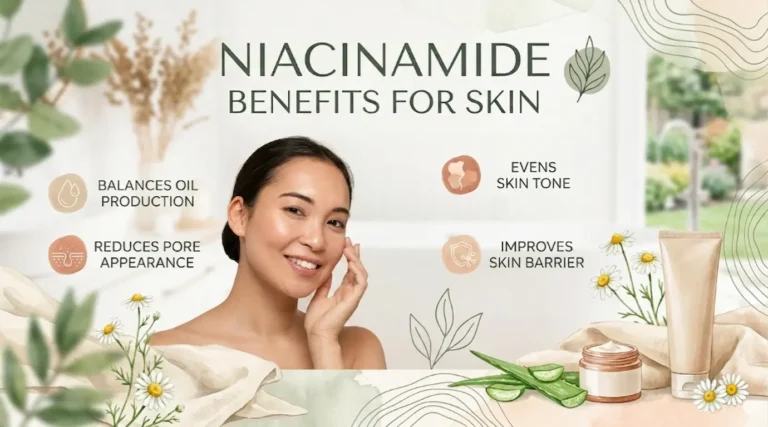
For example, niacinamide is a well-established skincare ingredient commonly used to support the skin barrier and improve the appearance of uneven skin tone.
The important factor is not whether an ingredient sounds natural.
The important question is whether the ingredient has a useful purpose and is properly formulated.
4. Skin Barrier Support
Your skin barrier helps protect the body from environmental stress while reducing excessive moisture loss.
Harsh cleansing, excessive exfoliation, very hot water, overuse of active ingredients, and unsuitable products can contribute to dryness and irritation.
A good skincare routine should therefore focus on:
- Gentle cleansing
- Adequate moisturization
- Avoiding unnecessary irritation
- Sun protection
- Consistent skincare rather than aggressive short-term treatments
This is especially relevant in Pakistan, where heat, sunlight, dust, and environmental pollution can place additional stress on exposed skin.
Ingredients Commonly Avoided in Gentle Skincare
There is no universal list of “toxic chemicals” that everyone must avoid. Ingredient safety depends on concentration, formulation, exposure, and individual sensitivity.
However, people looking for a gentle, sulfate-free, paraben-free skincare routine may choose to avoid or minimize certain ingredients.
Sulfates
Sulfates such as SLS and SLES are cleansing agents used to create lather.
Some people tolerate them well, while others may experience dryness or irritation, particularly with frequent use.
Parabens
Parabens are preservatives used to prevent microbial growth in cosmetic products.
They have been extensively studied and are permitted at regulated concentrations in many markets. However, some consumers prefer paraben-free formulations.
Artificial Fragrance
Fragrance mixtures can contain many individual compounds.
For people with fragrance sensitivity, strongly fragranced skincare may contribute to irritation.
Formaldehyde-Releasing Preservatives
Certain cosmetic preservatives can release small amounts of formaldehyde.
People who are sensitive to these ingredients may prefer products formulated without them.
Strong Skin-Lightening Ingredients
Some skin-lightening treatments can cause serious problems when misused or used without professional guidance.
Instead of chasing extremely fast whitening results, a safer skincare strategy is to focus on healthy-looking, even-toned skin, sun protection, hydration, and appropriate active ingredients.
Why Skincare in Pakistan Needs Special Consideration
Skincare routines should take local environmental conditions into account.
Pakistan has many regions with:
- Strong sunlight
- High summer temperatures
- Humidity
- Dust
- Air pollution
- Hard water in some areas
- Seasonal changes in dryness and humidity
These conditions can affect how your skin feels and behaves.
For example, someone with oily skin may find their face becomes significantly more oily during hot and humid weather, while another person may experience dryness or irritation from excessive cleansing.
This is why there is no single skincare routine that works perfectly for everyone in Pakistan.
Instead, choose products according to your:
- Skin type
- Skin concerns
- Climate
- Sensitivity
- Age
- Existing skincare routine
Which Ingredients Can Be Useful for Pakistani Skin?
Several widely used skincare ingredients can have useful roles when properly formulated.
Niacinamide
Niacinamide is a form of vitamin B3 commonly used in skincare.
It can help support the skin barrier and is frequently included in routines targeting the appearance of excess oil, uneven skin tone, and enlarged-looking pores.
Vitamin C
Vitamin C is an antioxidant commonly used in skincare to support brighter-looking skin and help protect against oxidative stress caused by environmental factors.
Because vitamin C formulations vary considerably in stability and concentration, product formulation matters.
Aloe Vera
Aloe vera is commonly used in skincare products designed to provide a soothing and hydrating feel.
It can be particularly appealing in hot weather when the skin feels uncomfortable or dry.
Argan Oil
Argan oil is rich in fatty acids and vitamin E and is commonly used in moisturizers, hair products, and conditioning formulations.
Botanical Extracts
Plant extracts can provide useful compounds to skincare formulations, but “botanical” does not automatically mean non-irritating.
The quality, concentration, extraction method, and complete formulation all matter.
Does Organic Skincare Work More Slowly?
Not necessarily.
The speed of results depends on the specific ingredient, concentration, formulation, skin concern, and consistency of use, rather than simply whether a product is organic or synthetic.
For example, moisturization can make skin feel softer very quickly, while improvements in uneven tone or other long-term concerns may require consistent use over several weeks.
Skincare should therefore be judged by realistic results over time, rather than overnight promises.
Be cautious of products promising:
- Instant whitening
- Permanent fairness
- Overnight removal of pigmentation
- Immediate wrinkle removal
- Guaranteed acne elimination
Healthy skincare is generally a process, not an overnight transformation.
Is Natural Skincare Safe for Sensitive Skin?
Natural does not automatically mean hypoallergenic.
A person can react to:
- Essential oils
- Fragrance
- Botanical extracts
- Plant proteins
- Preservatives
- Other natural ingredients
If you have sensitive skin, introduce one new product at a time and consider a patch test before applying it extensively.
If you have persistent redness, swelling, severe irritation, painful acne, or another ongoing skin problem, it is better to consult a qualified dermatologist rather than relying solely on cosmetic products.
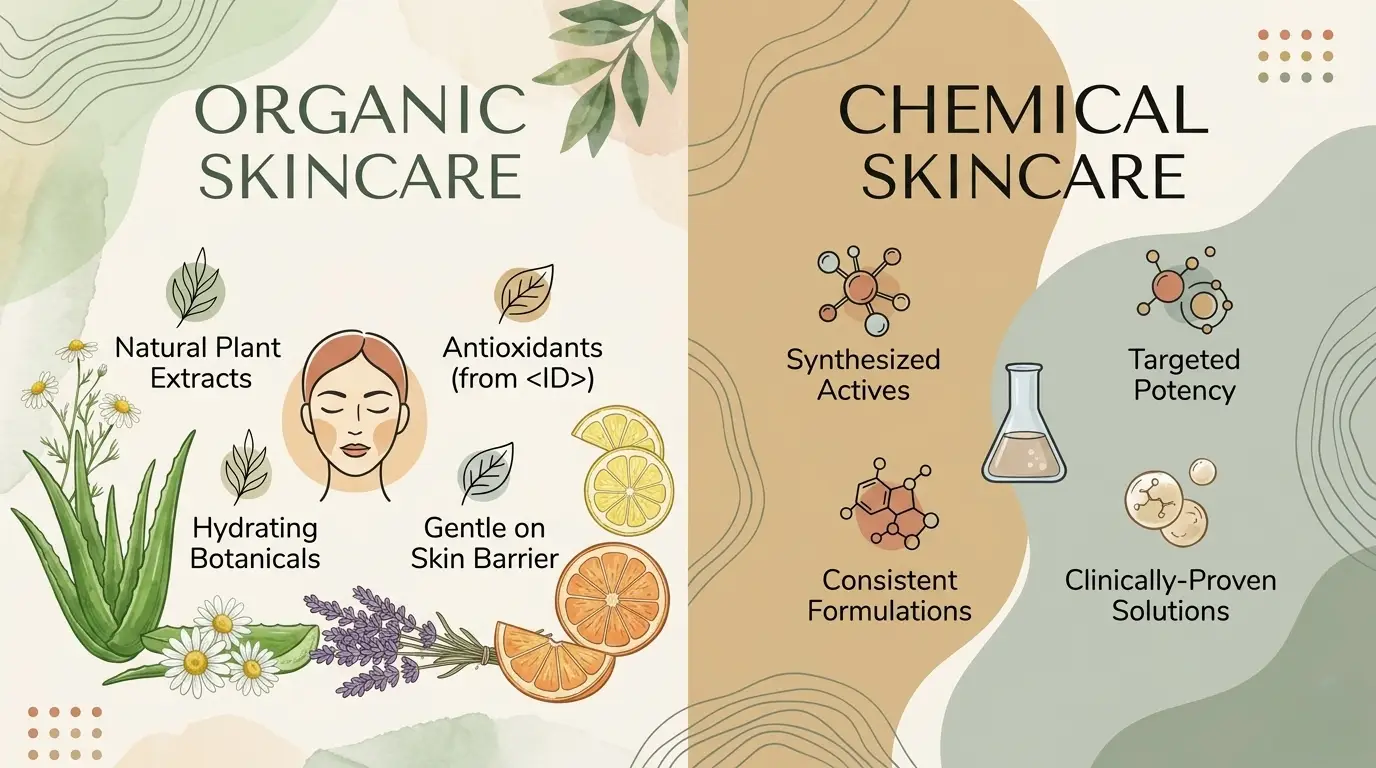
Organic vs Chemical Skincare: Comparison
| Feature | Organic / Natural-Focused Skincare | Conventional Skincare |
|---|---|---|
| Ingredient sources | Often plant-based or naturally derived | Natural, synthetic, or a combination |
| Sulfate-free options | Common | Available |
| Paraben-free options | Common | Available |
| Botanical ingredients | Frequently used | May be used |
| Synthetic ingredients | May still be present depending on formulation | Common |
| Effectiveness | Depends on formulation and active ingredients | Depends on formulation and active ingredients |
| Sensitive-skin suitability | Depends on the individual formula | Depends on the individual formula |
| Best choice | Based on ingredients and skin needs | Based on ingredients and skin needs |
The key takeaway
Do not choose skincare solely because it says “organic” or “chemical-free.”
Read the ingredients, understand what the product is designed to do, and choose according to your skin.
How to Build a Simple Skincare Routine in Pakistan
You do not need ten or fifteen products to take care of your skin.
A simple routine can be much easier to maintain.
Morning
Step 1: Cleanse
Use a gentle face wash suited to your skin type.
Step 2: Moisturize
Apply a lightweight moisturizer if your skin needs hydration.
Step 3: Sunscreen
Use a broad-spectrum sunscreen appropriate for your skin and follow the product’s application instructions.
Sun protection is particularly important in Pakistan because of substantial year-round sun exposure.
Evening
Step 1: Cleanse
Remove sweat, dirt, sunscreen, and other buildup with a suitable cleanser.
Step 2: Treatment
If needed, use a targeted skincare product containing an appropriate active ingredient.
Step 3: Moisturize
Finish with a moisturizer to support hydration and the skin barrier.
Consistency is usually more important than having a complicated routine.
How to Switch From Conventional to Organic Skincare
You do not need to replace everything in your bathroom overnight.
A gradual transition is often easier.
Start with your cleanser
Choose a gentle, sulfate-free face wash if your current cleanser leaves your skin feeling excessively dry or tight.
Add a suitable moisturizer
Look for ingredients that support hydration and your specific skin needs.
Simplify your routine
Avoid introducing several new products at the same time.
Read ingredient labels
Look beyond the front of the package and check the complete ingredient list.
Give your routine time
Some skincare changes can be noticed quickly, while others require several weeks of consistent use.
If a product causes significant burning, swelling, rash, or persistent irritation, stop using it and seek professional advice if necessary.
Organic Studio: Natural-Inspired Skin and Hair Care in Pakistan
At Organic Studio, our approach is centered around natural and plant-based personal care products for customers in Pakistan.
Our range includes skincare and haircare products formulated with ingredients selected for everyday personal care, with a focus on sulfate-free and paraben-free options.
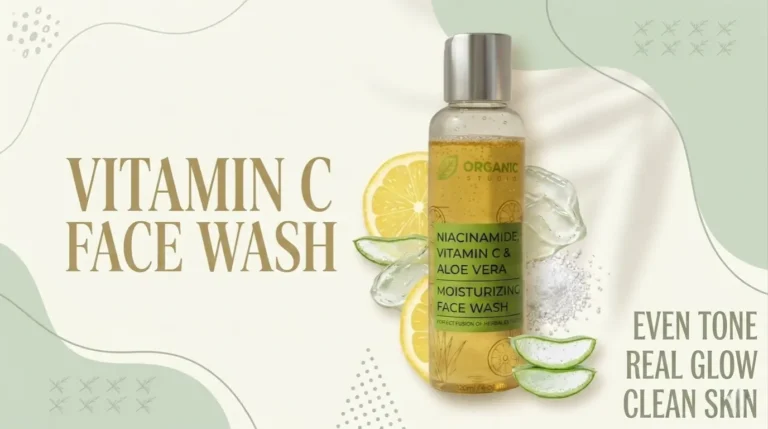
Niacinamide Vitamin C Aloe Face Wash
A daily face cleanser featuring ingredients such as niacinamide, vitamin C, and aloe vera, designed for people looking for a gentle everyday cleansing option.
Niacinamide Moisturizer
A daily moisturizing option designed to provide hydration while incorporating niacinamide into your skincare routine.
Onion Shampoo
A sulfate-free onion-based shampoo designed for people looking for a gentler alternative to harsh cleansing routines.
Onion Hair Mask
A conditioning hair treatment featuring ingredients such as argan oil and other conditioning components for a more complete haircare routine.
You can explore the Organic Studio range for skincare and personal care products with delivery available across Pakistan.
Frequently Asked Questions (FAQs) About Organic vs Chemical Skincare
Is organic skincare better than chemical skincare?
Not automatically. Organic skincare can be an excellent choice for people who prefer natural and plant-based formulations, but safety and effectiveness depend on the complete formulation rather than the word “organic” alone.
Is chemical skincare bad for your skin?
No. “Chemical” does not automatically mean harmful. Water, vitamin C, and plant extracts are also chemicals. Many synthetic skincare ingredients are safe and effective when appropriately formulated.
Is organic skincare safe for sensitive skin?
It can be, but natural ingredients can also cause irritation or allergies. Sensitive skin should be introduced to new products gradually, and patch testing can be helpful.
Is sulfate-free skincare better?
Sulfate-free products can be useful for people who find traditional cleansing agents drying or irritating. However, whether sulfate-free is better depends on your skin and the complete formulation.
Is paraben-free skincare better?
Paraben-free products are preferred by some consumers, but parabens are regulated preservatives with a long history of cosmetic use. The best choice depends on your personal preferences and the complete product formulation.
Which skincare ingredients are good for oily skin?
Niacinamide is commonly used in skincare routines for oily or combination skin. A gentle cleanser, lightweight moisturizer, and sunscreen can also be useful.
Is vitamin C good for Pakistani skin?
Vitamin C can be useful as part of a skincare routine because of its antioxidant properties and its role in supporting brighter-looking skin. Sunscreen remains essential for protecting skin from UV exposure.
Is aloe vera good for skin?
Aloe vera is commonly used in skincare because it provides a soothing and hydrating feel. Individual reactions can vary.
How long does skincare take to show results?
It depends on the product and the skin concern. Hydration can improve quickly, while changes involving uneven tone or other concerns can take several weeks of consistent use.
Can natural skincare remove pigmentation permanently?
No skincare product should promise permanent removal of pigmentation. Pigmentation has many possible causes, and sun protection is an important part of managing uneven skin tone.
Can I use organic skincare every day?
Many organic or natural-focused skincare products are designed for daily use. Always follow the individual product directions and stop using a product if it causes significant irritation.
Should I use sunscreen with organic skincare?
Yes. Choosing natural or organic-focused skincare does not replace sun protection. Sunscreen is an important part of a daytime skincare routine.
Final Verdict: Organic vs Chemical Skincare
The real skincare debate should not be “organic versus chemicals.”
A better question is:
“Which ingredients and formulation are best suited to my skin?”
Natural and plant-based ingredients can be excellent additions to a skincare routine. Scientifically studied synthetic ingredients can also be highly effective.
The smartest approach is to choose products with:
- Transparent ingredient lists
- Evidence-supported ingredients
- Appropriate formulations
- Gentle cleansing
- Adequate moisturization
- Suitable active ingredients
- Reliable sun protection
- Minimal unnecessary irritation
If you prefer natural, plant-based, sulfate-free and paraben-free personal care, Organic Studio provides skincare and haircare options designed for everyday use in Pakistan.
Explore Organic Studio skincare and personal care products and choose a routine that works for your skin, not just a product that makes big promises.
Key Takeaways
- Organic does not automatically mean safer.
- Synthetic does not automatically mean harmful.
- Ingredient quality and formulation matter more than marketing labels.
- Niacinamide, vitamin C, aloe vera, and plant oils can have useful skincare roles.
- Sensitive skin can react to both synthetic and natural ingredients.
- Sulfate-free and paraben-free products are options for consumers who prefer those formulations.
- Pakistani skin can be affected by sun exposure, heat, humidity, dust, and pollution.
- A simple, consistent skincare routine is usually better than using too many products.
- Sunscreen should be an important part of daytime skincare.
- Patch testing is useful when introducing unfamiliar products.
Organic Studio | Natural Organic Solutions for Skin & Hair Care in Pakistan